# Load packages and function
library(tidyverse)
library(here)
library(tmap)
library(showtext)
library(scales)
library(ggalluvial)
library(geobr)
library(sf)


source(here("R","clean.R"))


# Read data
mining_amazon <- read.csv(here("data", "mining_amazon.csv"))
mining_cerrado <- read.csv(here("data", "mining_cerrado.csv"))
mining_forest <- read.csv(here("data", "mining_mata_atlantica.csv"))

# Apply function to all biome datasets
mining_amazon <- clean_df(mining_amazon) %>% mutate(Biome = "Amazon")
mining_cerrado <- clean_df(mining_cerrado) %>% mutate(Biome = "Cerrado")
mining_forest <- clean_df(mining_forest) %>% mutate(Biome = "Atlantic Forest")


# Combine the rows from all dataframes and create column that sum all the mining area
total_mining <- bind_rows(
  mining_amazon,
  mining_cerrado,
  mining_forest
) %>%
  mutate(Total = rowSums(across(-c(Ano, Biome)), na.rm = TRUE))

# Transform to long format
mining_long <- total_mining %>%
  select(-ends_with(".1")) %>%  # Remove all .1 columns
  pivot_longer(
    cols = -c(Ano, Biome, Total),
    names_to = "Mineral",
    values_to = "Area") %>%
  mutate(
    Mineral = case_match(
      Mineral,
      "Ouro" ~ "Gold",
      "Ferro" ~ "Iron",
      "Alumínio" ~ "Aluminum",
      "Estanho" ~ "Tin",
      "Carvão.mineral" ~ "Coal",
      "Cobre" ~ "Copper",
      "Calcário" ~ "Limestone",
      "Minerais.de.Classe.2" ~ "Class 2",
      "Rochas.ornamentais" ~ "Ornamental rocks",
      "Nióbio" ~ "Niobium",
      "Manganês" ~ "Manganese",
      .default = Mineral
    )
  ) %>% drop_na(Area)

# Filter data to 2024 and calculate percentage
data_2024 <- mining_long %>%
  filter(Ano == 2024) %>%
  group_by(Biome, Mineral) %>%
  summarise(Area = sum(Area, na.rm = TRUE), .groups = "drop") %>%
  group_by(Biome) %>%
  mutate(
    Percentage = Area / sum(Area) * 100,
    Mineral = if_else(
      dense_rank(desc(Area)) <= 5,
      Mineral,
      "Other"
    )
  ) %>%
  group_by(Biome, Mineral) %>%
  summarise(Percentage = sum(Percentage), .groups = "drop") %>%
  mutate(
    Biome = factor(Biome, levels = c("Amazon", "Atlantic Forest", "Cerrado"))
  )

# Prepare data for 1985 and 2024 comparison
sankey_data <- mining_long %>%
  filter(Ano %in% c(1985, 2024), !is.na(Area), Area > 0) %>%
  group_by(Ano, Mineral) %>%
  summarise(Area = sum(Area, na.rm = TRUE), .groups = "drop") %>%
  group_by(Ano) %>%
  mutate(
    Percentage = Area / sum(Area) * 100,
    Mineral = if_else(
      dense_rank(desc(Area)) <= 8,
      Mineral,
      "Other"
    )
  ) %>%
  group_by(Ano, Mineral) %>%
  summarise(
    Area = sum(Area, na.rm = TRUE),
    Percentage = sum(Percentage),
    .groups = "drop"
  )

# Define biome color palette
biome_colors <- c(
  "Amazon" = "#758E4F",
  "Atlantic Forest" = "#33658A",
  "Cerrado" = "#B37761"
)


# Define mineral color palette for pit mining
mineral_colors <- c(
  "Gold" = "#DABA7E",
  "Iron" = "#AB6062",
  "Aluminum" = "#5E6284",
  "Tin" = "#D8CCB5",
  "Coal" = "#2F4F4F",
  "Copper" = "#B87333",
  "Limestone" = "#BFC6C3",
  "Class 2" = "#859D8B",
  "Ornamental rocks" = "#8B7355",
  "Niobium" = "#556F7A",
  "Other" = "#695152"
)


# Plot 1: Mining by year and biome
total_mining <- total_mining %>%
  mutate(Biome = factor(Biome, levels = c("Cerrado", "Atlantic Forest", "Amazon")))

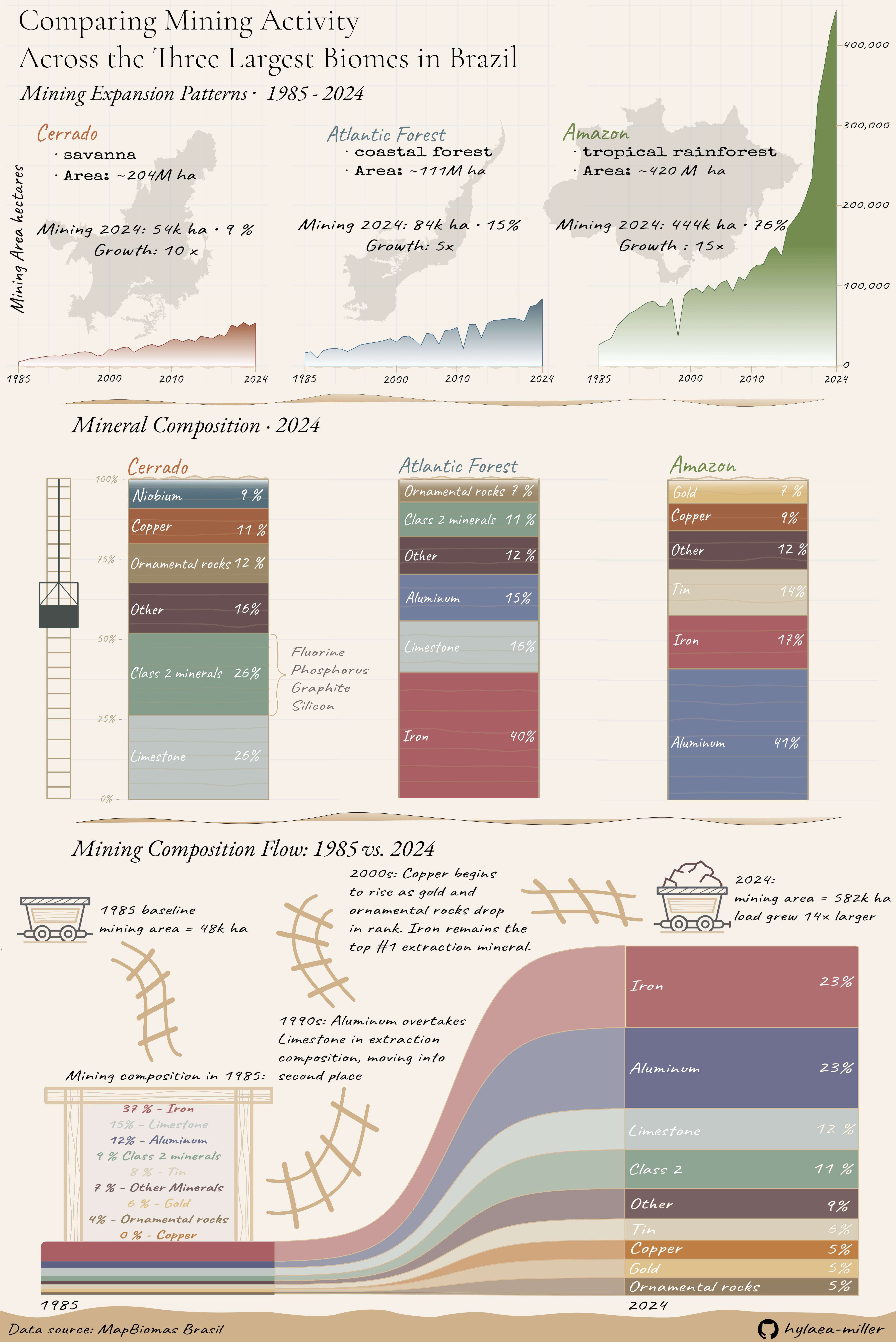
plot1 <- ggplot(total_mining, aes(x = Ano, y = Total, fill = Biome)) +
  geom_area() +
  facet_wrap(~Biome) +
  scale_fill_manual(values = biome_colors) +
  scale_y_continuous(labels = scales::comma_format()) +
  theme_minimal() +
  labs(
    x = "Year",
    y = "Mining Area (hectares)",
    title = "Mining Expansion Patterns Across Brazil's Three Largest Biomes (1985-2024)",
    subtitle = "Amazon shows steep growth post-2015, while Atlantic Forest and Cerrado grew more steadily"
  ) +
  theme(legend.position = "none",
        plot.title = element_text(
                                          face = "bold",
                                          size = rel(1.5),
                                          lineheight = 1.3,
                                  color = "#2C3E50"
                                          ),
        plot.subtitle = element_text(
                                     size = rel(1.2),
                                     color="#7F8C8D",
                                     ),
      plot.caption = element_text(
      size = rel(1.3),
      color = "#7F8C8D",
      hjust = 0,
      face = "italic",
      margin = margin(t = 10)
    ),
       axis.text = element_text(size = rel(1.3)),
    axis.title.x = element_text(
                                size = rel(1.3),
                                margin = margin(t = 15)),
    axis.title.y = element_text(
                                size = rel(1.3),
                                margin = margin(r = 10))
    )


# Create a function to generate the mining‑composition plot for a selected biome
plot_biome <- function(biome_name) {
  data_2024 %>%
    filter(Biome == biome_name) %>%
    mutate(Mineral = fct_reorder(Mineral, Percentage)) %>%
    ggplot(aes(x = "", y = Percentage, fill = Mineral)) +
    geom_col(width = 0.6) +
    scale_fill_manual(values = mineral_colors) +
    scale_y_continuous(labels = percent_format(scale = 1), expand = c(0, 0)) +
    labs(title = biome_name, x = NULL, y = "Percentage of Mining Area") +
    theme_minimal() +
    theme(
      legend.position = "none",
      plot.title = element_text( face = "bold", size = rel(1.7), color = "#2C3E50"),
      axis.text = element_text(size = rel(1.5), color = "#34495E"),
      axis.title.x = element_text(size = rel(1.5), face = "bold", color = "#34495E")
    )
}

plot2_cerrado <- plot_biome("Cerrado")
plot2_atlantic <- plot_biome("Atlantic Forest")
plot2_amazon <- plot_biome("Amazon")


# Adjust data to the sankey plot
sankey_data <- sankey_data %>%
  complete(
    Ano,
    Mineral,
    fill = list(Area = 0)
  )

# Order minerals by 2024 (descending)
mineral_order_2024 <- sankey_data %>%
  filter(Ano == 2024) %>%
  arrange(desc(Area)) %>%
  pull(Mineral)

# Order minerals by 1985 (descending)
mineral_order_1985 <- sankey_data %>%
  filter(Ano == 1985) %>%
  arrange(desc(Area)) %>%
  pull(Mineral)

sankey_data <- sankey_data %>%
  mutate(
    Mineral = factor(Mineral, levels = mineral_order_1985)
  )

# Plot Sankey diagram
plot3 <- ggplot(
  sankey_data,
  aes(
    x = factor(Ano),
    y = Area,
    stratum  = Mineral,
    alluvium = Mineral
  )) +
  geom_flow(
    aes(fill = Mineral),
    alpha = 0.6,
    curve_type = "sigmoid",
    width = 0.4 ) +
  geom_stratum(
    aes(fill = Mineral),
    alpha = 0.9,
    width = 0.4
  ) +
  geom_text(
 stat = "stratum",
  aes(
    label = if_else(
      as.integer(as.character(Ano)) == 2024,
      paste0(Mineral, "\n", round(Percentage, 1), "%"),
      ""
    )),
  color = "white",
  size = 3.5,
  fontface = "bold"
) +
  scale_fill_manual(values = mineral_colors, drop = FALSE) +
  labs(title = "Changes in Brazil's Mining Composition, 1985–2024") +
  theme_void() +
  theme(
  axis.text.x = element_text(),
  legend.position = "none",
  plot.title = element_text(
      face = "bold",
      size = 18,
      hjust = 0.5,
      color = "#2C3E50",
      margin = margin(b = 5, t = 20) ),
  plot.caption = element_text(
      size = rel(1.5),
      color = "#7F8C8D",
      hjust = 0,
      face = "italic",
      margin = margin(t = 10)))


# Read Brazil biomes data
biomes <- read_biomes(year = 2019)

# Plot the biomes
biomes <- plot(st_geometry(biomes))